

Quick answer
Boomi is a platform-independent integration and data platform used to connect applications and data across multi-vendor estates, with cloud, on-premises and edge deployment through its distributed Atom runtime. It is owned by Francisco Partners and TPG. Managed iPaaS is the alternative for teams who want integration outcomes without operating a platform.
Key takeaways
- Core use case: Boomi connects applications and data across multi-vendor estates, with more than 1,000 enterprise connectors and a distributed Atom runtime that processes locally.
- Deployment breadth is its differentiator. Cloud, on-premises and edge, including local processing where data cannot leave a boundary.
- Boomi changed category in 2026. It no longer describes itself as an integration company. The stated positioning is data activation, with AI agents as the primary interface replacing traditional UIs.
- Ownership: Francisco Partners and TPG Capital since 2021, when Dell Technologies divested it. Not Dell.
- Alternatives split into two groups. Self-service iPaaS platforms you operate: Celigo, Informatica, Jitterbit, MuleSoft, SnapLogic, TIBCO, Workato. And managed iPaaS, where the provider operates the integrations for you: ONEiO.
What is Boomi?
Boomi is a cloud-based iPaaS provider that enables businesses to connect applications, data, and systems, both on-premises and in the cloud. Boomi simplifies complex integration processes and helps organizations streamline workflows, automate tasks, and improve data accuracy.
Founded in 2000, acquired by Dell Technologies in 2010, and divested to private equity firms Francisco Partners and TPG Capital in 2021, Boomi now operates independently with 20,000+ customers globally. The platform is popular in healthcare, financial services, manufacturing, and the public sector—industries where compliance certifications (FedRAMP, HIPAA, SOC 2) are table stakes.
At its core, Boomi solves the "integration maze" problem: when your organization runs dozens of SaaS tools, legacy systems, and custom applications that all need to share data, someone has to build and maintain the connections. Boomi automates the bridge-building. You design workflows visually, Boomi runs the infrastructure, and your data flows where it needs to go.

What is Boomi used for?
Boomi is used by thousands of companies worldwide to streamline their integration needs. Due to its high-security standards, it’s particularly beneficial for larger companies in highly regulated sectors, such as healthcare and public services.
Some of the most common Dell Boomi use cases are:
- Application integrations: Connect SaaS and on-premises applications like Salesforce, NetSuite, SAP, and Microsoft Dynamics.
- Data integrations: Synchronize data across multiple systems to ensure consistency and accuracy.
- B2B/EDI integrations: Facilitate secure data exchanges with trading partners using EDI standards
- ETL: Transforming data into a preferred format and moving it between various applications is the key feature of all iPaaS solutions. Just like its competitors, Boomi does a great job at extracting, transforming, and loading data.
- API management: Design, deploy, and manage APIs to enable seamless data sharing across applications.
- Workflow automation: Automate complex business processes and workflows to improve efficiency.

Boomi is especially popular among businesses looking to accelerate digital transformation and streamline operations.
What is Boomi AtomSphere?
Boomi AtomSphere is the core product of Boomi by Dell Technologies. The comprehensive iPaaS platform offers a suite of tools for various integration needs:
- Boomi Atoms
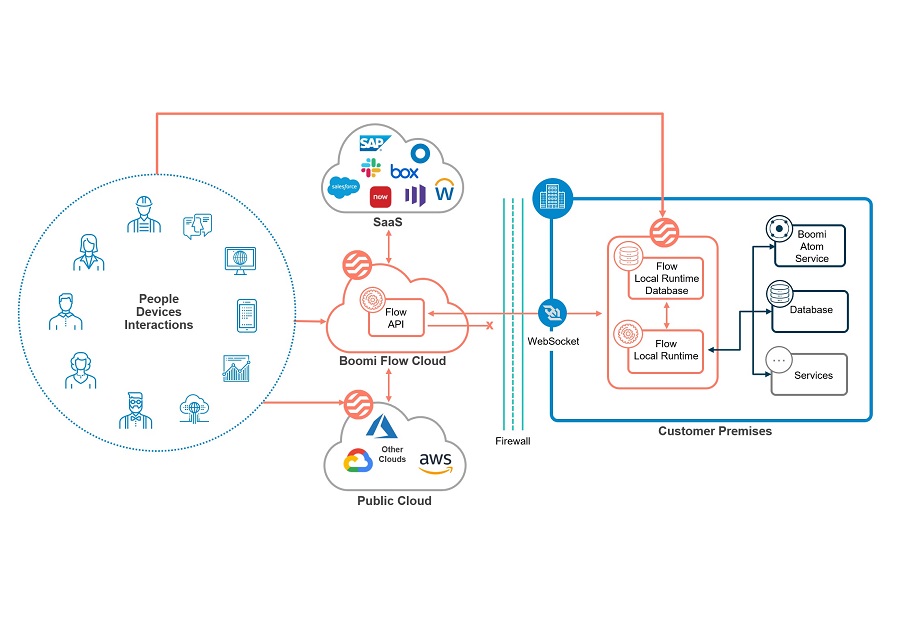
Boomi Atoms are essentially engines used to execute integration processes. Atoms can be deployed in the cloud or on-premises, which makes Boomi a perfect hybrid integration platform (HIP).
- Visual interface
AtomSphere offers a drag-and-drop visual interface that simplifies the design of integration workflows, making it accessible even to non-technical users.
- Pre-built connectors
Boomi provides a vast library of pre-built connectors for popular applications and data sources, speeding up the integration process.
- API management
AtomSphere allows users to build, manage, and monitor APIs, enabling businesses to create custom integrations and data-sharing solutions.
- Master data hub
As the name suggests, it’s a hub for managing your organization’s data. Boomi’s master data hub’s purpose is to manage and synchronize master data across systems, ensuring data consistency and accuracy.
- Flow
Flow is a low-code platform for building customer journeys and workflow applications, extending integration capabilities beyond data and applications.
Why is Boomi popular?
Boomi has become a popular choice among enterprise companies due to its flexibility, ease of use, and enterprise data security, which includes both standard and specialty certifications.
- Ease of use: The drag-and-drop interface and pre-built connectors make integration projects faster and simpler.
- Flexibility: Boomi supports various integration scenarios, including cloud-to-cloud, cloud-to-on-premises, and B2B integrations.
- Data security: Boomi customers have full control over the encryption/decryption process of their data with an external keystore. Dell Boomi’s certifications include ISO, SOC I/SOC II, CAIQ, FedRAMP/StateRAMP, HIPAA/HITECH, and more.
- Speed: With its visual interface and pre-built connectors, Boomi enables rapid deployment of integration projects.
- Community and support: Boomi offers a strong community and extensive documentation to help users get the most out of the platform.
Boomi’s pricing structure
Boomi offers a tiered pricing model based on features, number of connectors, and data volume. Currently, Boomi supports 5 different pricing plans: Base, Professional, Pro Plus, Enterprise, and Enterprise Plus.
According to past and existing customers the price is negotiable. The approximate cost for each connector (NetSuite, Salesforce, Workday etc.) is $5000/year.
Boomi limitations in IT service integration
Despite its solid offering, Boomi comes with a list of limitations that businesses must take into account before investing in the platform:
- Cost: Boomi can be expensive for businesses with extensive integration needs, especially as usage scales.
- Learning curve: While user-friendly, mastering complex integrations may require prior coding knowledge.
- Performance issues: Handling large data volumes or complex workflows can sometimes result in performance bottlenecks.
- Customization limits: Some unique integration scenarios may require custom scripting beyond the capabilities of pre-built connectors.
What changed for Boomi in 2026
Boomi changed what it calls itself. It no longer describes itself as an integration company. The current positioning is data activation, with AI agents framed as the primary interface replacing traditional user interfaces.
The May 2026 product slate follows that framing. Boomi Connect is a managed Model Context Protocol service bridging AI interfaces including Claude, Gemini, ChatGPT Enterprise and Copilot to more than 1,000 enterprise tools with authenticated, metered execution. An MCP Registry consolidates Boomi-built servers and third-party tools into one governed catalogue. Boomi Orchestrate composes workflows, APIs, data models and agents from a described business problem. Agent SIM tests agent behaviour before production. Boomi Companion lets coding agents build and deploy integrations from natural language. Knowledge Hub provides managed RAG, Meta Hub handles metadata governance, and DataDetective scans for sensitive data across integrations.
Boomi reports more than 30,000 customers and 1,000+ connectors.
What this means for the evaluation. If you are buying Boomi to run integrations, you are buying from a vendor whose product strategy has moved up the stack. That is not automatically bad, and the platform underneath is still strong. It does mean checking where integration sits on the roadmap relative to the agent work, and what that implies for support and development attention over a multi-year contract.
Top Boomi alternatives
ONEiO: the managed iPaaS alternative
ONEiO is managed iPaaS: a managed integration service that delivers iPaaS outcomes without the customer operating a platform. ONEiO designs, runs, monitors and maintains the integrations, with SLA-backed outcomes and 24/7 operations. Customers decide how much control they keep.

Key ONEiO advantages
- Fully managed service – While Boomi is a good option for organizations that want to build and maintain their own integrations, ONEiO eliminates that burden. Our team operates, automates, and optimizes integrations, removing the need for in-house technical expertise.
- Format-agnostic processing – Supports JSON, XML, CSV, and proprietary data formats, ensuring maximum compatibility across different systems.
- Enterprise-grade security – ONEiO provides SOC 2 compliance, field-level encryption, and role-based access controls, ensuring integrations remain secure and compliant.
- No-code configuration – Boomi requires hands-on configuration, while ONEiO provides a fully managed, no-code service that adapts to evolving business needs.
- Predictable cost structure – Boomi’s pricing fluctuates based on usage and features, whereas ONEiO offers a subscription-based model focused on integration outcomes rather than technical overhead.
When ONEiO is the better choice
You want integration outcomes without staffing an integration team. Choose Boomi when you need data management and MDM alongside integration, or edge processing where data cannot leave a boundary.
One integration connects multiple endpoints. No point-to-point custom work for each new connection. Customer systems stay as they are and keep evolving independently.
"Before, 100%, it was very complex... every time you add a customer, there's another environment to go into." — Michael, MHP
Continuity is somebody's job. Microservices spread across geographic sectors with load balancing. Persistent queuing so data is not lost when a system on either end goes down. AI-powered monitoring 24/7/365.
"Both parties gave their own truth, like own ticketing systems." — Visa, Paulig
Outcomes are committed, not attempted. Integration specialists own security and compliance for the integrations themselves, not just for the platform underneath them.
"Stop losing sleep over integrations." — Paula, Telia
When Boomi is the better choice
- You need master data management or data governance alongside integration.
- You need edge processing, running integrations locally where data cannot leave a physical boundary.
- Your estate is genuinely multi-vendor and you want to avoid tying the integration layer to an application vendor.
- You want to build and govern your own AI agent estate. Boomi's 2026 slate is substantial here.
Bottom line on Boomi
Boomi is one of the broadest platforms in the category, and its deployment flexibility is a real advantage in estates that include on-premises and edge systems.
The development worth registering is that Boomi is no longer primarily selling integration. It renamed its own category to data activation and put agents at the centre. The integration platform underneath is still there and still good. It is just no longer the product.
For teams already at capacity, that is the thing to weigh. The 2026 roadmap adds work before it removes any.