

Quick answer
Boomi is a platform-independent integration and data platform covering integration, data management and MDM, with cloud, on-premises and edge deployment, owned by Francisco Partners and TPG. Celigo is an integration platform built around prebuilt integration apps, strongest in ecommerce and NetSuite-centric estates. ONEiO is managed iPaaS: integration outcomes delivered as a service.
Integration platforms let you orchestrate data flowing across different applications, IT systems and business services. While this sounds straightforward, there are literally thousands of different ways to manage your integrations. As an enterprise IT service leader you need to find the solution that suits your needs the best.
In this article, we compare Boomi and Celigo. These are two of the best-known platform as a service (iPaaS) vendors with very different value propositions. After brief introductions, we’ll go through a head-to-head comparison and offer alternatives to consider.
Key takeaways
What is Boomi
Boomi is a popular integration platform that provides a cloud-based low-code environment for integrating diverse applications, managing APIs, automating workflows, and synchronizing data across on-premises and cloud systems.
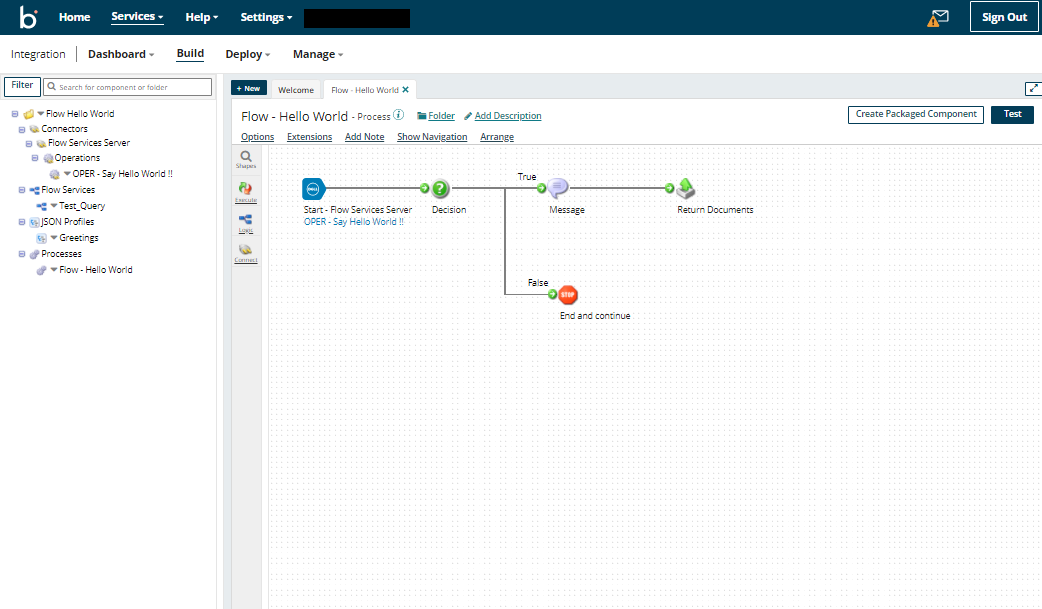
Boomi was originally founded in 2000 with a focus on on-premise data integrations. With over 20,000 customers worldwide, Boomi has built up a broad service offering, including B2B/EDI management and real-time event processing.
Boomi was acquired by Dell Technologies Inc. in 2010 and divested in 2021. Today, Boomi is owned by Francisco Partners and TPG Capital.
What is Celigo
Celigo is one of the leading iPaaS solution designed to streamline business processes by automating integrations between various applications and systems. Its core functionalities include pre-built connectors for cloud-based and on-premises applications, workflow automation tools, and data mapping capabilities.
Celigo helps businesses to connect their CRM, ERP, e-commerce platforms, marketing automation tools, and other critical systems, facilitating data synchronization and process automation. Celigo is also known for it's integrator.io platform mainly focused on the needs of Mid-market customers. For smaller businesses, two common self-service alternatives integrator.io are Make.com and Zapier.

Boomi vs. Celigo integration platform comparison
As an IT service leader you need to find a solution that suits your key jobs to be done.
Let’s explore how Boomi and Celigo compare in five common integration scenarios: API management, data integration, B2B/EDI integration, application integration, and system integration.
API Management
Boomi supports API integrations within its iPaaS offering. The platform includes API Lifecycle (management) tools to oversee your APIs from creation to retirement. Boomi's API Proxy allows you to securely expose your APIs, while API Analytics gives insights into usage patterns.
Celigo's API management solution enables communication between software systems via APIs. It provides tools to design, deploy, monitor, and manage APIs, ensuring secure connectivity across applications. Integrator.io supports REST and SOAP APIs and offers pre-built connectors and templates for quick integration setup, minimizing coding efforts.
Data Integration
Boomi features a number of advanced data integration capabilities. The platform includes pre-built connectors for databases and applications. Its visual mapping interface allows for simplified data transformations. In addition, the Master Data Hub supports data synchronization across multiple systems.
Celigo also offers data integration through integrator.io, which synchronizes data across systems in real-time or via scheduled batches. It supports databases, cloud applications, and on-premises systems. Users can map, transform, and cleanse data to maintain consistency and accuracy.
B2B/EDI Integration
Boomi provides comprehensive EDI (electronic data interchange) capabilities for B2B integrations, supporting multiple EDI standards such as X12 and EDIFACT. Its Trading Partner tools allow for detailed configuration of communication preferences. EDI mapping tools facilitate the transformation between EDI formats and internal data structures.
Celigo facilitates B2B/EDI integration through a B2B Manager solution, enabling the exchange of electronic documents between trading partners through standards like X12 and EDIFACT. It provides pre-configured EDI templates for orders, invoices, and shipping notices, streamlining setup and reducing manual entry errors.
Application Integration
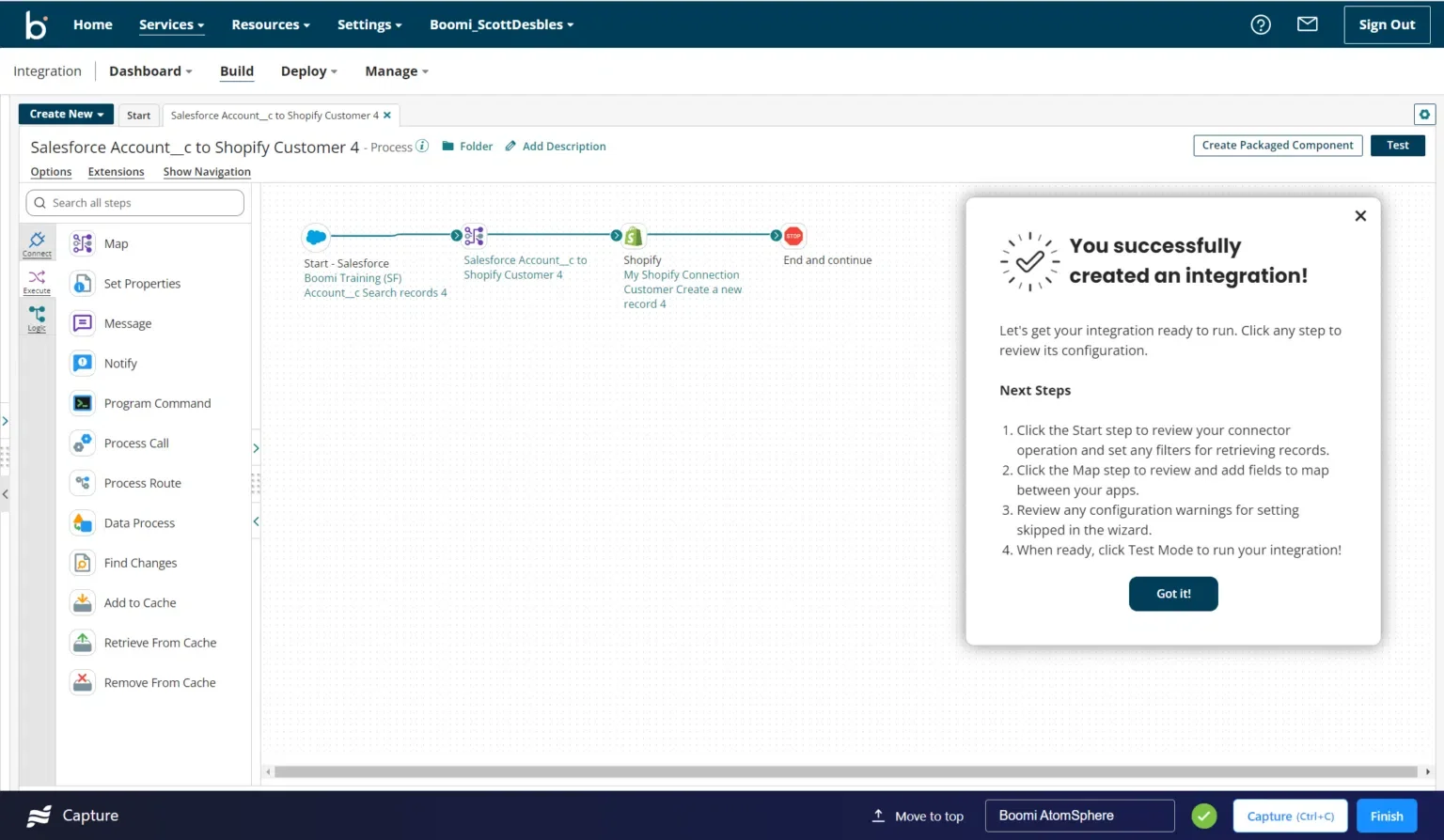
Boomi enables application integration through its library of AtomSphere connectors. Its low-code development environment allows for the creation of integration processes. Boomi also offers Integration Packs for common integration patterns, accelerating development.
Celigo has pre-built connectors for SaaS applications like Salesforce, NetSuite, and Shopify through a drag-and-drop interface and automated workflows. In addition, Celigo has an universal connector feature to configure bespoke integrations using HTTP, FTP, JDBC, AS2, GRAPHQL or Webhooks.

System integration
Boomi's Integration Packs provide templates for common integration scenarios. The platform supports both cloud-to-cloud and cloud-to-ground integrations, with the Atom runtime enabling processing close to data sources.
Celigo can also handle system integrations between ERP systems, CRM platforms, HR systems, and other enterprise applications. The toolkit includes data transformation, error handling, and monitoring features.
What changed for Boomi and Celigo in 2026
Both moved further in the last nine months than in the several years before.
Boomi changed what it calls itself. It no longer describes itself as an integration company. The positioning is now data activation, with AI agents framed as the primary interface replacing traditional user interfaces. The May 2026 slate included Boomi Connect, a managed Model Context Protocol service bridging AI interfaces including Claude, Gemini, ChatGPT Enterprise and Copilot to more than 1,000 enterprise tools, an MCP Registry, Boomi Orchestrate for composing workflows and agents from a described problem, Agent SIM for pre-production agent testing, Boomi Companion, Knowledge Hub, Meta Hub and DataDetective.
Celigo launched Ora and Agent Builder on 31 March 2026. Ora is a natural-language gateway: users describe what they need and specialised AI agents design the integration, troubleshoot errors and manage operations, with governance and auditability built in. Agent Builder is a low-code environment for AI-driven automations, paired with a Model Context Protocol server. Celigo frames the problem as the specialist bottleneck, meaning too few people who know how to build integrations.
What this means for the evaluation. Both are betting that AI changes who can build an integration. That is probably right.
It is a smaller bet than it looks, though, if your problem is service integration across organisational boundaries. Connecting your service desk to a customer's or a supplier's is not hard because the building is hard. It is hard because two organisations control the two ends, both keep changing them, and neither is obliged to warn the other.
Factors to consider when comparing Boomi and Celigo
When evaluating Boomi and Celigo as integration platforms, you need to weigh several key factors to determine which best suits their needs. Let’s examine four key areas: Scalability and Performance, Monitoring Capabilities, Security and Compliance, and Customer Community and Partner Ecosystem.
Scalability and Performance
- Boomi: Boomi offers a highly scalable cloud-native architecture, capable of handling complex, large-scale integrations. Its ability to process high volumes of data makes it suitable for enterprises with extensive integration requirements.
- Celigo: Celigo is also designed for scalability, allowing businesses to start small and expand as needed. The difference compared to Boomi is that it. is more geared to integrating with cloud-based CRMs like Netsuite and Salesforce. It excels in quickly adapting to changing business environments, making it ideal for small to medium-sized enterprises.
Monitoring Capabilities
- Boomi: Boomi provides robust monitoring tools that offer real-time insights into integration processes. Users can set alerts and track performance metrics, ensuring optimal system health and quick issue resolution.
- Celigo: Celigo offers intuitive monitoring capabilities with user-friendly dashboards. It provides visibility into integration flows and error management, allowing for efficient troubleshooting and management.
Security and Compliance
- Boomi: Boomi implements comprehensive security measures, including data encryption and secure authentication protocols. It complies with major standards like GDPR and HIPAA, making it a strong choice for industries with stringent security requirements.
- Celigo: Celigo emphasizes security through robust governance features and compliance with industry standards such as GDPR. Its security framework ensures that data is protected across integrations.
Customer Community and Partner Ecosystem
- Boomi: Boomi boasts a strong customer community and an extensive partner ecosystem. Its partnerships with various technology providers enhance its integration capabilities and offer a wide range of solutions.
- Celigo: Celigo has an active and supportive community, providing access to resources and shared assets. Its partnerships focus on popular platforms like NetSuite and Salesforce, offering seamless integrations for e-commerce and CRM solutions.
When comparing Boomi and Celigo, consider your organization’s specific needs and priorities. Boomi may be better suited for businesses requiring complex, large-scale integrations with extensive customization or on-premise solutions. In contrast, Celigo is ideal for organizations seeking quick, user-friendly solutions with cost-effective scalability across modern cloud solutions like Netsuite or Salesforce.
Why choose Boomi?
Boomi is ideal for enterprises requiring robust, large-scale integrations. It excels in environments where complex data transformations and real-time processing are critical.
Boomi Highlights:
- Extensive connector library for diverse business applications.
- Cloud-native architecture supporting hybrid on-premise and cloud integrations.
- Advanced features for real-time data synchronization and API management.
Why choose Celigo?
Celigo is well-suited for organizations seeking quick, user-friendly integration solutions. It’s particularly effective for businesses leveraging popular SaaS platforms like NetSuite and Salesforce.
Celigo Highlights:
- Extensive library of pre-built integrations for popular SaaS applications
- Cloud-native platform with strong support for cloud-to-cloud integrations eg. in Netsuite
- Specialized strength in e-commerce, finance, and marketing integrations
- Embedded iPaaS capabilities, allowing integration features to be built directly into SaaS applications
ONEiO as an Alternative to Boomi and Celigo
If you’re not sure if Boomi or Celigo is the best option for your integration needs, you may consider a third alternative, ONEiO.
.png)
ONEiO gives you a streamlined, no-code integration service that stands out for several reasons:
Effortless integrations as a service
While Boomi and Celigo have some low- and no-code functionality, ONEiO is the first integration platform that offers end-to-end integrations as a service. This is especially valuable in case you don’t plan to hire a full team of system integrators to maintain your integration ecosystem.
Integration automation beyond pre-built connectors
ONEiO supports a wide range of endpoint types and data formats, including JSON, XML, CSV, and plain text. It provides robust mechanisms for both push (using webhooks and REST/SOAP) and pull (via API, SFTP, SQL) data processing. This flexibility ensures that ONEiO can handle various integration scenarios with ease.
Security and compliance
ONEiO offers strong security features, including encrypted credentials and support for multiple authentication standards (Basic Authentication, Token, API Key, OAuth, etc.). It also allows connections to internal networks and supports reverse proxies or whitelisting. The platform is built on AWS and ensures high availability and GDPR compliance.
Business logic and data orchestration
ONEiO provides a no-code editor for creating business logic, transforming, and translating data. It supports various transformation options like regular expressions, case transformations, and date formatting. The platform’s rule robot automates rule creation based on common use cases, making it easy to adjust or add new rules without disrupting existing integrations.
.png)
When to choose ONEiO?
ONEiO is especially well suited for seamless ITSM integration across internal and externally managed IT services. It offers a turnkey solution for the complex integration needs of both global enterprises and IT service providers.
ONEiO highlights:
- ONEAi artificial intelligence model trained specifically for IT service integration.
- Faster time-to-value. Typical integrations take 2 weeks from idea to production.
- 100% satisfaction guarantee based on proven enterprise-grade integration service.
When ONEiO is not the right fit:
- You have a mature in-house integration engineering team and want maximum platform control. Buy the platform.
- You need master data management or data governance alongside integration. That is Boomi's, not ours.
- Your estate is ecommerce or NetSuite-centric and a packaged integration app covers the use case. Celigo will be faster.
- You need integration at the edge, processing locally where data cannot leave a physical boundary. That is Boomi's Atom runtime.
- You have exactly two systems to connect, once, and they will not change. A point-to-point build is cheaper.
What changes when integration is a service rather than a platform
ONEiO is a managed integration service, sometimes described as managed iPaaS. It delivers the same outcomes an iPaaS delivers, which is any-to-any connectivity, lifecycle management and cloud-native delivery, with one structural difference: ONEiO designs, runs, monitors and maintains the integrations, with SLA-backed outcomes and 24/7 operations. Customers decide how much control they keep.
Choose ONEiO when: you want integration outcomes without staffing an integration team, particularly where the integration crosses an organisational boundary. Choose Boomi or Celigo when you have mature in-house integration engineering and want maximum platform control.
One integration connects multiple endpoints. No point-to-point custom work for each new connection. Customer systems stay as they are and keep evolving independently.
"Making commitments that differentiate you... that helps me, especially in pitches between other managed service providers, because we can promise them we can connect your system to our system." — Michael, MHP
Continuity is somebody's job. Microservices spread across geographic sectors with load balancing. Persistent queuing so data is not lost when a system on either end goes down. AI-powered monitoring 24/7/365. Upgrades, migrations and partner-side changes handled without breaking flows.
"We don't hear anything like before five years or four years." — Gabriel, Trumpf
Outcomes are committed, not attempted. Integration specialists own security and compliance for the integrations themselves, not just for the platform underneath them. Issues are caught and resolved before they reach the business.
"In control." — Visa, Paulig
Who does the work comparison
Bottom line on Boomi vs. Celigo
Boomi if you need breadth: integration alongside data management and MDM, across a multi-vendor estate, with on-premises or edge processing. Celigo if your estate is narrower and a packaged integration will cover most of what you need.
Both spent 2026 making integrations easier to create, and both were right that too few people know how to build them.
For ITSM integration specifically, that is not usually the binding constraint. Connecting your service desk to a customer's or a supplier's is difficult because two organisations own the two ends and both keep changing them. What that needs is not a faster builder. It is somebody whose job is to keep the connection working when the other side moves.